Saturday, April 27, 2013

Hi every Mother,

I have create a new Page called "Daily Tips",
I think every mother need it,
It's a simple tips for easy life: decoration tips, health tips, home cleaning tips, children treatment tips and more.
This page will be daily updated, I just need your support to continue my work.


Wednesday, April 24, 2013

Anemia During Pregnancy


Anemia facts

*Anemia facts medical author: 
  • Anemia is a medical condition in which the red blood cell count or hemoglobin is less than
    normal.
  • For men, anemia is typically defined as hemoglobin level of less than 13.5 gram/100 ml and in women as hemoglobin of less than 12.0 gram/100 ml.
  • Anemia is caused by either a decrease in production of red blood cells or hemoglobin, or an increase in loss or destruction of red blood cells.
  • Some patients with anemia have no symptoms. Others may feel tired, easily fatigued, appear pale, a feeling of heart racing, short of breath, and/or worsening of heart problems.
  • Anemia can be detected by a simple blood test called a complete blood cell count (CBC).
  • The treatment of the anemia varies greatly and very much depends on the particular cause.

What is anemia?

Anemia is a medical condition in which the red blood cell count or hemoglobin is less than normal. The normal level of hemoglobin is generally different in males and females. For men, anemia is typically defined as hemoglobin level of less than 13.5 gram/100 ml and in women as hemoglobin of less than 12.0 gram/100 ml. These definitions may vary slightly depending on the source and the laboratory reference used

What causes anemia?

Any process that can disrupt the normal life span of a red blood cell may cause anemia. Normal life span of a red blood cell is typically around 120 days. Red blood cells are made in the bone marrow.
Anemia is caused essentially through two basic pathways. Anemia is caused by either:
  1. a decrease in production of red blood cells or hemoglobin, or
  2. an increase in loss or destruction of red blood cells.
A more common classification of anemia (low hemoglobin) is based on the Mean Corposcular Volume (MCV) which signifies the average volume of individual red blood cells.
  1. If the MCV is low (less than 80), the anemia is categorized asmicrocytic anemia (low cell volume).
  2. If the MCV is in the normal range (80-100), it is called a normocytic anemia (normal cell volume).
  3. If the MCV is high, then it is called a macrocytic anemia (large cell volume).
Looking at each of the components of a complete blood count (CBC), especially the MCV, a physician can gather clues as to what could be the most common reason for anemia in each patient.

Anemia During Pregnancy

The wonder and joy of pregnancy is matched by the body's ability to adapt to looking after the growing baby. In addition to the mother's physiologic needs, there is the additional need to provide the building blocks to optimally grow baby. All this construction requires energy and oxygen as the fuel that helps drive the engine.
Oxygen in the air that we breathe is delivered to the cells of the body by hemoglobin, a protein molecule found in red blood cells. The normal ranges for hemoglobin depend on the age and, beginning in adolescence, the gender of the person. For example, the normal ranges of hemoglobins for background comparison are:
  • Newborns: 17 to 22 gm/dl
  • Babies 1 week of age: 15 to 20 gm/dl
  • Babies 1 month of age: 11 to 15 gm/dl
  • Children: 11 to 13 gm/dl
  • Adult men: 14 to 18 gm/dl
  • Adult women: 12 to 16 gm/dl
  • Men after middle age: 12.4 to 14.9 gm/dl
  • Women after middle age: 11.7 to 13.8 gm/dl
Anemia is a decrease in the amount of hemoglobin and red blood cells. Anemia is a relatively normal finding in pregnancy. Plasma is the watery, noncellular component of blood. In pregnancy, there is an increase in plasma volume of the blood in order to help supply oxygen and nutrients to mother and baby. There can be a 20% increase in the total number of red blood cells but the amount of plasma increases even more causing dilution of those red cells in the body. A hemoglobin level of pregnancy can naturally lower to 10.5 gm/dL representing a normal anemia of pregnancy.
Nevertheless, the body needs a minimum amount of hemoglobin to supply the oxygen needs of the body and if it is lacking, the symptoms of anemia may occur. Symptoms of anemia include feeling increasingly tired, weak,short of breath with activity or at rest, a rapid heart rate, and a pale appearance to the skin. Lightheadedness or dizziness may occur when standing up too quickly or trying to physically exert. Symptoms occur because the body's oxygen requirements cannot be met by a decreased amount of hemoglobin contained in the fewer number of red blood cells.
If the pregnant mother had heavy prepregnancy menstrual flow, she may be anemic entering the pregnancy and the normal physiology of carrying a growing baby may make the anemia more pronounced. If there are two pregnancies close together, the mother's body may not yet have recovered, increasing the chances for anemia. It also can be difficult getting enough nutrition and iron with morning sickness. And the risk of anemia in pregnancy is even greater with multiple pregnancies, such as twins or triplets.
Anemia in pregnancy is common, but it is also frequently preventable through optimal diet and nutrition. The key is loading up on foods that are high in iron content like dark green leafy vegetables, eggs, and meat. As well, many foods like cereals and bread are iron fortified. If that doesn't work the health care professional may suggest an iron supplement to help replenish the body's stores. But in addition to iron, the body needs other building blocks to help make red blood cells including folic acid, which is an important vitamin to take to prevent potential damage to the growing baby's brain and spinal cord (neural tube defects).
A mother's physiology usually adapts well to the needs of a growing baby. Eating wisely can help the body cope with the physiology changes that are required. Eating wisely can, as a result, prevent the tiredness and weakness that can often accompany anemia. Basically, a healthy mother makes a healthy baby.

Can anemia be hereditary?

Yes, anemia may be genetic. Hereditary disorders can shorten the life span of the red blood cell and lead to anemia (for example, sickle cell anemia). Hereditary disorders can also cause anemia by impairing the production of hemoglobin (for example, alpha thalassemia and beta thalassemia).
Depending on the degree of the genetic abnormality, hereditary anemias may cause mild, moderate, or severe anemia. In fact, some may be too severe to be compatible with life and may result in death of the fetus (unborn infant). On the other hand, some of these anemias are so mild that they are not noticeable and are incidentally revealed during a routine blood work.

What are the symptoms of anemia?

Some patients with anemia have no symptoms. Others with anemia may feel:
  • Tired
  • Fatigue easily
  • Appear pale
  • Develop palpitations (feeling of heart racing)
  • Become short of breath
Additional symptoms may include:
  • Hair loss
  • Malaise (general sense of feeling unwell)
  • Worsening of heart problems
It is worth noting that if anemia is longstanding (chronic anemia), the body may adjust to low oxygen levels and the individual may not feel different unless the anemia becomes severe. On the other hand, if the anemia occurs rapidly (acute anemia), the patient may experience significant symptoms relatively quickly.

How is anemia treated?

Sometimes iron supplements will also be needed to correct iron deficiency. In severe anemia, blood transfusions may be necessary. Vitamin B12 injections will be necessary for patients suffering from pernicious anemia or other causes of B12 deficiency.The treatment of the anemia varies greatly. First, the underlying cause of the anemia should be identified and corrected. For example, anemia as a result of blood loss from a stomach ulcer should begin with medications to heal the ulcer. Likewise, surgery is often necessary to remove a colon cancer that is causing chronic blood loss and anemia.
In certain patients with bone marrow disease (or bone marrow damage from chemotherapy) or patients with kidney failure, epoetin alfa (Procrit, Epogen) may be used to stimulate bone marrow red blood cell production.
If a medication is thought to be the culprit, then it should be discontinued under the direction of the prescribing doctor.


Sunday, April 21, 2013

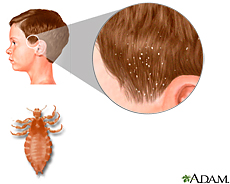
Head lice


Head lice facts

  • Head lice are parasites that are found on human heads. The wordlice is plural for louse.
  • Head lice are spread by personal contact or the sharing of combs, brushes, caps, and other clothing.
  • Head lice are a common problem with preschool and schoolchildren.

  • Head lice cause a tickling feeling of something moving in the hair,itching, and sores on the head.
  • The affected individual, family members also infected, and the home all should be treated.
  • Remember: one head louse + one head louse = two head lice = the beginning of a head-lice infection.
  • Very young children should be evaluated by a health care professional before beginning medications.

What are head lice?

Head lice are parasites that can be found on the heads of people. Infection with head lice is called pediculosis. (The head louse, Pediculus humanus capitis, is different from the lice that cause body and pubic-hair infections.)

How common is head lice infestation?

Head lice infection is very common. It has been estimated that up to one in every 10 children in school acquires head lice at some time. In one study, the estimated annual cost of head lice infestations in the United States was nearly $1 billion dollars

Who is at risk for getting head lice?

Anyone who comes in close contact with someone who already has head lice, or even their contaminated clothing and other belongings, is at risk for acquiring head lice. So it is easy to transmit head lice from one person to another. Preschool and elementary-school children (3-10 years of age) and their families are infected most often. Girls contract head lice more often than boys, and women contract more head lice than men. African-Americans rarely acquire head lice.

How in the world does a child get head lice?

A child can contract head lice in a number of ways.
  • Contact with an already infested person: Personal contact is common during play, school, or sports activities, and at school, home, slumber parties, or camp
  • Wearing infested clothing, such as hats, scarves, coats, sports uniforms, or hair ribbons
  • Using infested combs, brushes, or towels
  • Lying on a bed, couch, pillow, carpet, or stuffed animal that has recently been in contact with a person with lice


What do head lice look like?

There are three forms of lice, namely thenit, the nymph, and the adult louse.
Nit: Nits are lice eggs. Nits are hard to see and are often confused with dandruff or hair-spray droplets. Nits are found firmly attached to the hair shaft. They are oval and usually yellow to white. Nits take about a week to hatch.
Nymph: The nit hatches into a baby louse called a nymph. It looks like an adult he
ad louse but is smaller. Nymphs mature into adults about seven days after hatching. To live, the nymph must feed on blood.
Adult: The adult louse is about the size of a sesame seed, has six legs, and is tan to grayish-white in color. In people with dark hair, the adult louse looks darker. Females lay nits; they are usually larger than males. Adult lice can live up to 30 days on a person's head. To live, adult lice need to feed on blood. If the louse falls off a person, it dies within two day


What are the signs and symptoms of head lice infestation?

  • a tickling feeling of something moving in the hair;
  • itching (caused by the an allergic reaction to the bites);
  • sores on the head (caused by scratching);
  • these sores on the head can sometimes become infected;
  • irritability.

Where are head lice most commonly found?

Head lice are most frequently located on the scalp behind the ears and near the neckline at the back of the neck. Head lice hold on to hair with hook-like claws that are found at the end of each of their six legs. Head lice are rarely found on the body, eyelashes, or eyebrows.

Head Lice Treatment

Treatment of the individual and the infected family members
Over-the-counter (OTC) or prescription medications are used to treat the affected people and their families. Follow these treatment steps:
  1. Remove all clothing.
  2. Apply lice medicine, also called pediculicide, according to the label instructions. If your child has extra-long hair, you may need to use a second bottle. WARNING: Do not use a cream rinse or combination shampoo/conditioner before using lice medicine. Do not rewash hair for one to two days after treatment.
  3. Have the infested person put on clean clothing after treatment.
  4. If some live lice are still found eight to 12 hours after treatment but are moving more slowly than before, do not retreat. Comb dead and remaining live lice out of the hair. The medicine sometimes takes longer to kill the lice.
  5. If, eight to 12 hours after treatment, no dead lice are found and lice seem as active as before, the medicine may not be working. See your health care professional for a different medication and follow their treatment instructions.
  6. Nit (head lice egg) combs, often found in lice medicine packages should be used to remove nits and lice from the hair shaft. Many flea combs made for cats and dogs are also effective.
  7. After the initial treatment, check, comb, and remove nits and lice from hair every two to three days.
  8. Retreat in seven to 10 days.
  9. Check all treated people for two to three weeks until you are sure all lice and nits are gone.
Treating the house:

Treating the whole house is a laborious but important task. Follow these steps:
  1. Machine wash all washable clothing and bed linens that the infested person touched during the two days before treatment (to kill the lice and nits). Use the hot water cycle (130 F; 55 C) to wash clothes. Dry laundry using the hot cycle for at least 20 minutes.
  2. Dry clean clothing that is not washable (coats, hats, scarves, etc.), orstore all clothing, stuffed animals, comforters, etc., that cannot be washed or dry cleaned into a plastic bag and seal it for two weeks.
  3. Soak combs and brushes for one hour in rubbing alcohol, Lysol, or wash with soap and hot (130 F; 55 C) water and then place in bag and leave in freezer for two days.
  4. Vacuum the floor and furniture. Do not use fumigant sprays. (They can be toxic if inhaled.)

Reviewed by William C. Shiel Jr., MD, FACP, FACR on 5/29/2012


New Parent Mistakes


All parents make mistakes. Don't believe it? Just think about your own parents. You will no doubt come up with a laundry list of things they did wrong.The truth is no one is infallible -- especially new parents. But if you know the top 10 most common parenting mistakes, maybe you can keep from making them yourself. So here they are, along with tips to help you avoid making them.


1: Panicking Over Anything and Everything

Many new parents have overblown physical reactions to spitting up, vomiting, and other things a baby does,' explains New York City psychoanalyst Leon Hoffman, MD, 'and the baby picks up on that anxiety.' Hoffman is the director of the Pacella Parent Child Center. He tells WebMD that parents can literally waste the entire first year of their baby's life by sweating the small stuff. Is he having too many bowel movements or too few? Is she spitting up too much? Is she getting enough to eat or too little? Does he cry too much or not enough? Any of that sound familiar to you? Hoffman says, 'This worry gets in the way of being spontaneous and enjoying your infant's first year of life. Babies are far more resilient than we give them credit for.


2: Not Letting Your Infant Cry It Out

'We, as parents, think our job is to make sure the baby is not crying,' says Atlanta-based pediatric nurse Jennifer Walker, RN. "That's because we associate crying with the fact that we are doing something wrong and we need to fix it." Walker is coauthor of The Moms on Call Guide to Basic Baby Care. 'Babies are designed to cry,' she tells WebMD. They can be perfectly diapered and fed and still cry like you are pulling an arm off.'
For the most part, crying is just part of being a baby. But if your infant is inconsolable for an hour and crying is associated with fever, rash, or persistent vomiting, call your pediatrician as soon as possible.

3: Waking Baby Up to Breastfeed

Mistake or misconception? 'Breastfed babies can -- and should -- sleep through the night,' says Walker. 'But there's a common misconception that breast milk is not thick enough to get an infant through the night. But it is possible and beneficial for breastfed babies -- and their moms -- to sleep through the night.

4: Confusing Spit-Up and Vomit

Walker says, 'The difference (between spit-up and vomit) is frequency, not forcefulness. Spit-up can absolutely fly across the room.' Vomiting, however, is all about frequency. 'If your baby is vomiting with a gastrointestinal virus,' she says, 'it will come every 30 or 45 minutes regardless of feeding.

5: Not Sweating a Fever in a Newborn

Any fever over 100.4 rectally in the first three months of a baby's life is an emergency,' Walker says. The one exception is a fever that develops within 24 hours after an infant's first set of immunizations. Walker tells WebMD, 'Some parents may just say, 'He feels warm' and give the baby Tylenol. But that's a parenting mistake in this age group. An infant's immune system is not set up to handle an infection on its own.


6: Not Properly Installing the Car Seat

Any new parent who has tried knows that installing a car seat is -- or at least can seem like -- rocket science. 'Once you have chosen the right seat,' Walker says, 'go to your local fire station or Babies"R"Us or another chain store to make sure you have installed it correctly.' Or go to get help putting it in. 'Your infant's life,' she says, 'may depend on it.

7: Neglecting Oral Care

Many new parents don't think about their newborns teeth or oral health until it is too late,' says Saul Pressner, a New York City-based dentist. Your baby is never too young for you to start encouraging good oral health habits. Pressner offers tips to help new parents know how to do that:
  • Don't give your infant milk in bed once teeth have erupted. "This will increase the risk of developing cavities," Pressner says, adding that the cavities are also known as baby bottle decay.
  • Use a wet gauze to wipe down your baby's gums, he says. And start using a toothbrush when the baby turns 1.
  • It's also important to make sure your child is getting enough fluoride. Fluoride is found naturally in water and aids in cavity prevention. Some towns have fluoridated water through the taps. 'If yours doesn't,' says Pressner, 'ask your dentist about supplements.


8: Ignoring Your Marriage

Staying connected within the marriage when you first have a child is really important and can be overlooked,' says John C. Friel, PhD. Friel is a licensed psychologist with private practices in Reno, Nev., and Minneapolis, Minn. 'Any weakness in that relationship will get magnified by having a child,' he says. 'And while you have to focus a lot on the new baby, you must somehow maintain a sense of being a couple.' Friel is also the coauthor of The 7 Worst Things (Good) Parents Do. Friel advises to avoid this common parenting mistake by 'making sure that you are not zoning out when you are not with the baby.

9: Fighting Too Much (or Too Little) in Front of Your Baby

Even a 3-month-old will pick up vibes,' Friel says. In terms of fighting, he suggests you ask yourself 'Is it scary?' or 'Is it frequent?' 'Look at the intensity and frequency of your fights,' he says. 'Snapping every now and then is a normal part of living with another person. And when people start to suppress too much, it's just as bad as going to the other extreme.

10: Trusting Unreliable Sources for Parenting Advice

Many new parents go to the wrong places for parenting advice,' says Walker. 'This is a classic parenting mistake,' she says, and she advises that you be careful about where you get your information. Walker says, 'WebMD.com, the Federal Centers for Disease Control and Prevention (CDC), and the American Academy of Pediatrics are reputable and useful when making decisions about general medical care and immunizations.


---------------------------------------------------------------------------------------------


Pregnancy and Exercise


Maintaining a regular exercise routine throughout your pregnancy can help you stay healthy and feel your best.
 Regular exercise during pregnancy can improve your posture and decrease some common discomforts such as backaches and fatigue. 
There is evidence that physical activity may prevent gestational diabetes (diabetes that develops during pregnancy), relieve stress, and build more stamina needed for labor and delivery.


If you were physically active before your pregnancy, you should be able to continue your activity in moderation. Don't try to exercise at your former level; instead, do what's most comfortable for you now. Low impact aerobics are encouraged versus high impact.

The pregnant competitive athlete should be closely followed by an obstetrician.
If you have never exercised regularly before, you can safely begin an exercise program during pregnancy after consulting with your health care provider, but do not try a new, strenuous activity. Walking is considered safe to initiate when pregnant.

The American College of Obstetrics and Gynecology recommends 30 minutes or more of moderate exercise per day on most if not all days of the week, unless you have a medical or pregnancy complication.

Who Should Not Exercise During Pregnancy?

If you have a medical problem, such as asthma, heart disease, or diabetes, exercise may not be advisable. Exercise may also be harmful if you have a pregnancy-related condition such as:
  • Bleeding or spotting
  • Low placenta
  • Threatened or recurrent miscarriage
  • Previous premature births or history of early labor
  • Weak cervix
Talk with your health care provider before beginning an exercise program.
 Your health care provider can also give you personal exercise guidelines, based on your medical history.

What Exercises Are Safe During Pregnancy?

Most exercises are safe to perform during pregnancy, as long as you exercise with caution and do not overdo it.
The safest and most productive activities are swimming, brisk walking, indoor stationary cycling, step or elliptical machines, and low-impact aerobics (taught by a certified aerobics instructor). These activities carry little risk of injury, benefit your entire body, and can be continued until birth.

Tennis and racquetball are generally safe activities, but changes in balance during pregnancy may affect rapid movements. 
Other activities such as jogging can be done in moderation, especially if you were doing them before your pregnancy. You may want to choose exercises or activities that do not require great balance or coordination, especially later in pregnancy.


How Soon Can I Exercise After Delivery?

It is best to ask your health care provider how soon you can begin your exercise routine after delivering your baby.
Although you may be eager to get in shape quickly, return to your pre-pregnancy fitness routines gradually. Follow your health care provider's exercise recommendations.
Most women can safely perform a low-impact activity one to two weeks after a vaginal birth (or three to four weeks after a cesarean birth). Do about half of your normal floor exercises and don't try to overdo it.

Tell us about your previous experience.
Do you exercised during pregnancy?
And any kind of sport do you prefer?  

you may also like;

Saturday, April 20, 2013

Twin Pregnancy: Follow Pregnancyexercise.co.nz with Gemma During her Twin Pregnancy!

I am so excited this is our new blog and video series following one of my clients Gemma through her twin pregnancy! 

It was almost 2 months ago now when Gemma first contacted me about personal training. She had just found out she was pregnant with her first and wanted to make an appointment to come and see me for personal training sessions. We scheduled an appointment and I advised her to see if she could get an early scan just to check everything was OK. I tend to always suggest this now based on my own and clients past experiences. A scan at 6-9 weeks is the most accurate for dates.

It's TWINS!
A couple of days later Gemma contacted me to say that the scan went well and it was TWINS and should she still come and see me?! Oh yes, definitely and huge congratulations was my reply. Gemma was 8 weeks in to her pregnancy when we met for  the first appointment at the gym where I base my personal training business. I was very surprised when I heard that she was feeling OK not tired or even sick.....yet!

Over the course of her first trimester Gemma had no pregnancy nausea and minimal tiredness, she is born to breed as her Obstetrician pointed out!

Gemma has worked hard over the last few years, she is her own boss and the business is now well established. Due to this she is quite lucky in that she was able to rest when she needed, which probably reduced most of the tiredness and fatigue often associated in those first few weeks. Wow I remember my first pregnancy and all most every afternoon I would put my feet up, read and fall asleep, oh the benefits of being self-employed but oh so different pregnancies two and three!

First Pt Session:
When I first meet a client I discuss many points including past exercise, injury history, nutrition, hydration, sleep and stress levels along with a postural assessment. This allows me to prescribe a specific and individual program to follow. 

Now  I know I have a tendency not to practice what I preach (I don't have the time...) and Gemma was no different preferring high intensity exercise over re-hab. She is a qualified physiotherapist and was in need of a complete re-hab program to prepare her for her pregnancy, birth and beyond. We started with the basics and ensured correct activation of transverse abdominus (TVA for short) was the first thing we did.

Exercise:
The first 3 video's featured are from 11-13 weeks, the exercises concentrate on strengthening weak core muscles and correcting alignment. Ultimately leading to reducing any possible lower back pain and reducing pregnancy diastasis recti-abdominal muscle separation.


Before her pregnancy Gemma was very fit managing to exercise 5-6 times a week and would regularly take part in high intensity /interval type training, boxing and spinning. Originally  Gemma intended to maintain her current exercise program but things changed pretty quickly!

Through the first trimester she averaged exercise 3-4 times a week, 3 of those were strength based sessions as you will see in the video. A typical week was:-
Mon: Pregnancy Exercise Group (Positively Pregnant- PP) Wed: PT Session  Fri: PP Group
Sat or Sun: Walk 40-50 minutes


Lower Abdominal Leg Slides: Activation of TVA and One leg Glute Lifts
For Correct activation of your Transverse abdominus click here


Hip Bridge at 11 weeks: Strengthen your Glutes!


Gemma is lucky as being a physiotherapist she knows exactly what to do. Her partner is also a physiotherapist so she and the babies will benefit from regular massage. Massage increases blood flow, improving circulation so not only does the mum benefit but the babies too as the blood flow via the placentas is also improved. 

From 14 weeks Gemma has been able to increase her exercise and going into her 2nd trimester her weekly exercise program now looks like this:-
3 x a Week 7-8km Fast Walk,  2 x PP sessions and 1x 60min PT session


Challenging Exercises Week 13: Side Lunge with pull and walking lunges


Wellness:
During the first trimester Gemma wasn't sick but she did experience headaches. Headaches can be quite common during pregnancy and I have 'googled' this as I too suffered but still can't find the real reason why these migraine type headaches happen and are experienced by many during their first trimester. What I have found that helps is keeping hydrated so drink at least 2 litres of water a day, eat at regular intervals-every 2-3 hours and getting enough sleep so make sure you get to bed early! 

Ultra Sound Scans:

Gemma was so nervous before the 13 week scan as you would expect but it is very different when you have two babies to check and a higher risk pregnancy. The scan went really well so Gemma and her partner were very relieved, both babies were good size and they got a very cool 4D scan of them both looking like they were hugging each other it was very cute. Time to tell everyone!

Next Month- Early Second trimester: Multiple birth groups, breastfeeding, kettle bell and suspension training, 18 week Anatomy ultra sound scan and Gemma celebrates her 30th Birthday with an overseas holiday-traveling pregnant with twins.

Make sure you subscribe to our youtube channel or this blog so you don’t miss out on following Gemma’s twin pregnancy.

If you feel any pain or discomfort whilst exercising, stop. If pain continues consult you L.M.C or G.P. The information included in this article has been written by Lorraine Scapens: She is not able to provide you with medical advice the information is used as guidelines. You cannot hold Lorraine liable in any way for any injuries that may occur whilst training.

Exercises During Pregnancy


Maintaining a regular exercise routine throughout your pregnancy can help you stay healthy and feel your best. Regular exercise during pregnancy can improve your posture and decrease some common discomforts such as backachesand fatigue. There is evidence that physical activity may prevent gestational diabetes (diabetes that develops during pregnancy), relieve stress, and build more stamina needed for labor and delivery.


If you were physically active before your pregnancy, you should be able to continue your activity in moderation. Don't try to exercise at your former level; instead, do what's most comfortable for you now. Low impact aerobics are encouraged versus high impact.
The pregnant competitive athlete should be closely followed by an obstetrician.
If you have never exercised regularly before, you can safely begin an exercise program during pregnancy after consulting with your health care provider, but do not try a new, strenuous activity.

The American College of Obstetrics and Gynecology recommends 30 minutes or more of moderate exercise per day on most if not all days of the week, unless you have a medical or pregnancy complication.

Who Should Not Exercise During Pregnancy?
If you have a medical problem, such as asthma, heart disease, or diabetes, exercise may not be advisable. Exercise may also be harmful if you have a pregnancy-related condition such as:
Bleeding or spotting
Low placenta
Threatened or recurrent miscarriage
Previous premature births or history of early labor
Weak cervix

Talk with your health care provider before beginning an exercise program. Your health care provider can also give you personal exercise guidelines, based on your medical history.
What Exercises Are Safe During Pregnancy?
Most exercises are safe to perform during pregnancy, as long as you exercise with caution and do not overdo it.
The safest and most productive activities are swimming, brisk walking, indoor stationary cycling, step or elliptical machines, and low-impact aerobics (taught by a certified aerobics instructor). These activities carry little risk of injury, benefit your entire body, and can be continued until birth.

Exercises:

The most important exercise for pregnancy is Pelvic Floor Exercise during pregnancy. Strengthening the pelvic muscles is of utmost importance as it holds the bowl, bladder and womb in place. A strong pelvic helps in the in the second stage labour enabling contraction. Also this exercise reduces the chances of stress incontinence developed after delivery

  • .To practice pelvic exercise you need to contract and release your pelvic muscles repeatedly.
  • Pull in your belly button towards the spine, draw in your vagina as if trying to stop the flow of urine
  • Hold this for a few seconds and then release
  • Ensure your muscles are fully relaxed before repeating the procedure
  • Practice this exercise for ten rounds every day
WalkingWalking is the best and the safest exercise during pregnancy. It tones your muscles, improves blood circulation, helps draw in more oxygen and relaxes mind to get peaceful sleep. Walking helps to improve your stamina during labour.
  • Consider small walks at intervals during the day rather than a long walk
  • Form a schedule like walk on three days in a week for 20 – 30 minutes and gradually increase the time to 30 – 60 minutes
  • Maintain moderate speed while walking, do not brisk walk
  • Take a ‘talk test’ while walking to assess your speed i.e. if you can say a full sentence without huffing and puffing your speed is right
  • Walk with your back straight, do not lean forward or bend backwards
  • Make sure you wear the right kind of foot wear while walking
  • Stretch your muscles before and after walking, this improves flexibility
---------------------------------------------------------------------------------------------------