Showing posts with label Children care. Show all posts

Friday, May 31, 2013

19 Healthy Snacks for Kids

 brought to you byCulturelle®.

Your kids are going to snack. Here's how to make it healthier.


Kids are snacking more than ever, and as a parent, you've got the power to make those snacks helpful.
Yes, they're getting extra calories from snacks. And yes, snacks are often too sugary.
Still, some snacking can be good for children -- within limits.
“Kids, especially younger ones, have erratic eating habits, and healthy snacks can fill in nutrition gaps,” says Maryann Jacobsen, RD.
Snacking can help kids keep their energy up, make up for skimpy or skipped
breakfasts, and provide fuel before after-school sports or other activities.


What Makes a Good Snack

Think of snacks as mini meals.
Most of the time, feed your child the same types of foods you would at breakfast, lunch, and dinner, including low-fat dairy and other lean protein sources, such as eggs, whole grains, fruits, and vegetables.
Good snacks provide carbohydrates, protein, fiber, and some healthy fat. Generally speaking, foods rich in protein or fiber help kids stay fuller for longer, and they’re packed with the nutrients kids need to thrive.  
There’s debate about how many calories a child’s snack should provide, but it makes sense to aim for about 100 calories for smaller children, to upwards of 300 calories for active teenagers. Let your child’s hunger rule what he or she eats.

19 Simple, Do-It-Yourself Snacks

Making your own snacks to have at home or take with you is usually your best, most budget-friendly choice. Try these:
  1. A small amount of guacamole or low-fat bean dip, and baked snack chips or toasted whole wheat pita bread, broken into chips
  2. Low-fat microwave popcorn tossed with Parmesan cheese
  3. Trail mix ingredients: 1/4 cup each: whole-grain cereal, raisins or dried cranberries, and 2 tablespoons each: sunflower seeds or chopped nuts
  4. Low-fat ice cream or frozen yogurt topped with fresh fruit
  5. Snack size (8 ounce) box of low-fat plain or chocolate milk and whole wheat pretzels
  6. Whole-grain crackers, string cheese, and mango slices
  7. Cooked or raw vegetables with low-fat ranch dressing, and a hard-boiled egg
  8. Instant oatmeal made with milk in the microwave with 1 teaspoon cocoa powder stirred in and topped with sliced raspberries or strawberries
  9. Whole-wheat pretzels with peanut butter, almond butter, or sunflower seed butter
  10. Cherry chocolate smoothie: Combine 1 cup low-fat milk, 1/2 cup vanilla low-fat yogurt, 1/2 cup frozen or fresh pitted cherries, and 2 tablespoons dark chocolate chips in a blender or food processor and mix until smooth
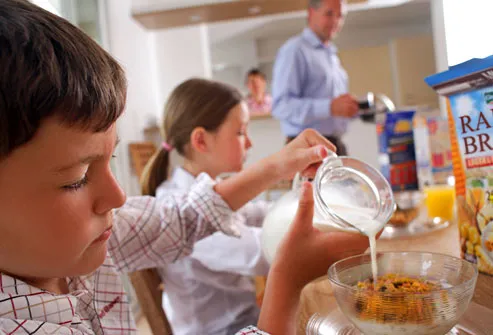
  11. Bowl of whole-grain cereal and low-fat milk
  12. Edamame
  13. Small container of low-fat Greek yogurt
  14. Mini bagel spread with low-fat cream cheese and strawberry jam, and low-fat milk
  15. Hummus and whole wheat pita chips
  16. Half a sandwich and glass of orange juice fortified with calcium and vitamin D
  17. Slice of pizza  
  18. Hard-boiled egg and whole-grain roll
  19. Pistachios in the shell and glass of chocolate milk


Be a Choosy Snacker

What if other people offer your child less-than-nutritious foods?
“Teach kids to honor their hunger, and that they don’t always have to eat what’s offered to them," says Jacobsen, who's a mother of two.
Also, be a snack role model. What do your kids see you snacking on? As kids get older, they generally follow your lead, so choose your own snacks wisely.

Read also:
--------------------------------------------------------------------------------------------------------------------

SOURCES:
Karen Ansel, RD.
Maryann Jacobsen, RD, nutrition consultant and blogger.
Piernas, C. Health Affairs, 2010. 
Reviewed by Brunilda Nazario, MD on January 28, 2013
© 2011 WebMD, LLC. All rights reserved.

Essential Nutrients for Kids A to Z

Vitamin A
Why kids need it: Vitamin A is key for kids' good eyesight, especially for color and night vision. It also gives their immune systems an infection-fighting boost.
Where to find it: Fill kids' plates with carrots and other orange vegetables and fruits -- like cantaloupe and sweet potatoes -- and fill their glasses with fortified milk.

B Vitamins

Why kids need them: Kids need B vitamins (or B complex), which include thiamin, riboflavin, niacin, folate, pantothenic acid, B6, B12, and biotin, to make and use energy. Without enough B vitamins, kids can get anemia.
Where to find them: You can find Bs in just about every food group. Whole grains, fish, chicken, meat, leafy greens, and dairy are packed with them.


Vitamin C

Why kids need it: A daily helping of C helps ward off sneezes and sniffles by helping kids' bodies fight infections. It also speeds the healing of scrapes and other boo-boos.
Where to find it: Kids can drink a glass of orange juice or, better yet, eat an orange. Other fruits and vegetables are also great C sources. Try strawberries, tomatoes, cantaloupe, and sweet red peppers.

Vitamin D

Why kids need it: For strong bones and teeth, kids need daily D. Vitamin D helps the body absorb calcium so it can build bones.
Where to find it: The skin makes vitamin D when the sun hits it. But because the UV rays that fuel vitamin D production also can cause cancer, watch getting your D from the sun. Instead, add fortified milk, cereal, tuna, or eggs to kids' diets.

Calcium

Why kids need it: Kids need calcium to build strong bones and teeth. Too little can lead to a higher chance of bone disease later in life.
Where to find it: Dairy is the best place to find calcium. A few servings of low-fat milk and yogurt every day should keep your kids' bones strong and healthy.

Choline

Why kids need it: Choline isn't a vitamin, but it's still an important nutrient. Cells need it for their shape, and the nervous system needs it to speed messages throughout the body.
Where to find it: Kids' bodies don't make their own choline, so they have to get this nutrient from foods like eggs, fish, beef, chicken, and broccoli.


Iron

Why kids need it: Iron isn't just for pumping in the gym. It also helps pump blood in the body. Iron is found in the part of red blood cells that moves oxygen to the rest of the body.
Where to find it: Beef up on lean meat, or give kids other iron-filled foods, like beans, dark leafy greens, and iron-fortified cereal.


Magnesium


Why kids need it: Magnesium is one of the building blocks of the body's cells, and it's important in making energy. A diet rich in magnesium also will keep your child's heart pumping strongly into adulthood.
Where to find it: Bran cereal, brown rice, tofu, beans, almonds, and other nuts are all rich sources of magnesium.
undefined


Potassium

Why kids need it: Almost every cell and organ in the body needs potassium to work as it should. Potassium also is important for blood pressure, keeping the heart pumping and the muscles working when kids are running around.
Where to find it: Bananas are loaded with potassium, but you also can find it in sweet potatoes, white beans, skim milk, and low-fat yogurt.


Zinc

Why kids need it: Zinc may help kids stop colds by helping their immune systems fight viruses and other disease-causing germs. The body needs zinc to grow and develop.
Where to find it: Chicken, beans, and fortified breakfast cereals are filled with zinc.

undefined

Fortified Foods

The best way to make sure your child gets the nutrients he or she needs is to serve a variety of foods. Fortified orange juice, breads, and cereals also can help with balanced nutrition. Worried about a picky eater? Talk to your pediatrician about a daily vitamin and mineral supplement


Read also:
19 Healthy Snacks for Kids
--------------------------------------------------------------------------------------------------------------------
via:
http://www.webmd.com
Reviewed by Hansa D. Bhargava, MD on January 15, 2013

Monday, May 13, 2013

children's sleep at night strengthens memory

Researchers from the University of Tubingen in Germany that young people who sleep well enough at night are getting a strong memory,


which may explain why the school performance bad when young people who do not sleep well, they are capable of more than one adult to convert tacit knowledge to know the plain,something that often happens in the learning process; obvious knowledge where that is information that is stored in the mind, while tacit knowledge is to be able to do anything without knowing how we do it.


Dr. Jean Bourne and his colleagues at the University of Tuebingenwere trained eight young people and adults pressed the button wich have a certain result, after sleeping for the night were asked to remember what they learned, was the performance of young people better than adults, since the activity brain waves slower when the children during their sleep, and this linked to the obvious memory performance, and considered that the children's ability to transform the experience of implied to know clearly is an advantage of the advantages of a good sleep with them.


It is worth mentioning that previous studies reported that the rate of natural sleep for humans ranges between seven to eight hours, and sleep less than normal humans much of the health problems and nervousness, and leads to an imbalance of hormones, including the hormone responsible for regulating appetite; which may leadto obesity.

Saturday, May 11, 2013

Ways to succeed in persuading your child


Perhaps preoccupation with many things make a lot of mothers do not pay attention to their necessary needs to care for their children, "I'm a Mother" will show you an educational methods that you need.
talk, convince, mother


Back to home
Mothers often faces problem in convince oldest child that a new baby will come to the family, And because of the growing child's jealousy which make a lot of problems for the mother during pregnancy, Especially when she go out with her child on a picnic trip or in a special games place, she will find it's very difficult to convince him that she is not able to continue play with him, Therefore psychologists specialists advised mother of the following.

1 - Create a relationship between the biggest child and his brother during pregnancy period by  giving him chance to observe a newborn in the family.
2 - Give him a chance to preparing newborn's needs.
3 - Convinced him that coming child w'll be his companion in play.
4 - When you feel tired, inspire to your biggest child that his brother tired of playing and would like to rest.

Use bathroom
Your child will have exceeded age of two years before being able to recognize the feelings or needs to go to the bathroom,
Then develops physical control for a long time, and going to bathroom becomes faster and easier process when it is ready and when choosing potty, choose one not easily reversed.
Signs indicating the extent of his readiness for toilet training:

- Continuous stands and looks at you, or tries to tell that he might make stool or urine.
- Understand about what you say when show him the potty and show him what it is.
- Able to sit on it even if do not need that.

Way to learn to walk
- Useful to your child learns to walk on bare feet.
- When he starts to walk well, bought his first pair of suitable shoes.
- Measure his feet to obtain the appropriate measurement.
- Check the appropriate shoe for your baby's feet once a month.


Monday, May 6, 2013

How to motivate your children


Show them how

Want your child to eat her vegetables? Eat your vegetables! Get up and go for a walk together to show her that being active is fun. You are the best role model your child can have. Children start to mimic their parents while they’re still babies, so start early and resist the urge to bribe your child to cooperate and avoid teaching unhealthy habits.
family


Reward them with mum or dad time

Instead of bribing your child with video games or a trip to the cinema where they are sedentary, make active time together a reward. Kick a ball around. Go on a bike ride together. Even let your child plan the whole day.

Why this works: Children crave your attention – especially if they have to share time with siblings. Never underestimate how much one-to-one attention means to your kids, even teenagers.


Don’t use food as a reward

Using sweets or junk food as a prize teaches your children to use food to soothe their 
feelings. Learning to use food for comfort can set them up for an unhealthy relationship with food.  According to one study, adults who were rewarded and punished with food as children were more likely to binge eat and diet.
Withholding treats because of misbehaviour, “No ice cream for you!”, isn't good either. The forbidden food becomes more attractive


Praise effort, not just results

Children need praise. If you want to motivate them, focus on their effort rather than the end result. When your child shows you a picture he made, don't just say it's great. Praise your child for how hard he worked on it. Note specific details. If you’re trying to get your child to learn a new sport, talk about how proud you are that he’s practicing kicking or running. Don’t focus on winning or losing a game.
Your child will start to feel the value in working hard on something, and get a sense of motivation from within. 

child drawing picture

Stay calm, don’t shout

When you're telling your child to do something, or disciplining him, stay calm. This is your chance to be a role model for healthy emotional management. Kids can learn how to manage their emotions by watching you. Be concise and clear.
  1. Tell him what he has to do.
  2. Tell him by when he needs to do it.
  3. Explain the consequences for not following through.
  4. Stick to your agreement and don't allow negotiation.

Show her exercise feels good

If you’re trying to get your children to move more, help them realise that exercise feels good! Activity triggers the release of endorphins, the feel-good chemicals in the brain. Get moving together. After you both go on a bike ride or play tennis, chat about how you feel. This encourages your child to notice the same feeling herself and creates a natural motivation to be active. Ideally, your child should be on the move at least 60 minutes a day.

Get out the pedometers

Still looking for a way to convince your kids it’s good to move? Buy inexpensive pedometers, or step counters, for the whole family. Start a family contest: Note down everyone's daily steps on a chart you keep on the fridge.
You don't even need a prize for the weekly winner. Using the gadget itself, along with some friendly competition, can motivate your kids to move throughout the day.

Get inspired: Watch others

No matter what habit you’re trying to instill, children look up to other people. Use that to your advantage when you’re trying to get them to move more. Build on the inspiration from the London 2012 Olympics. Go to performances where they can watch acrobats or dancers. Take them to see a rugby or football match. It might motivate them a lot more than anything you can say. Then go and kick a ball or play catch with your child.

girl watching game with family

Create a cooking challenge

Want to encourage a picky eater to try new veg? Choose one from the market or supermarket that neither of you have ever had before. Go home and find a recipe.
Or give your older child or teenager a selection of healthy ingredients and challenge him to decide how to turn them into dinner. Being invested in how it turns out may inspire him to try new foods.

Offer choices and some control

Instead of ordering your children to do a job, give them options. Ask if they want to do a task now or in a few minutes. Ask if they would rather take out the rubbish or empty the dishwasher. Kids fight back when they feel like they have no control. Resisting you becomes a way of asserting themselves.
Giving them some say will help motivate them.
Plus, giving them choices now, teaches them how to make healthy choices later.


Sunday, April 21, 2013

Head lice


Head lice facts

  • Head lice are parasites that are found on human heads. The wordlice is plural for louse.
  • Head lice are spread by personal contact or the sharing of combs, brushes, caps, and other clothing.
  • Head lice are a common problem with preschool and schoolchildren.

  • Head lice cause a tickling feeling of something moving in the hair,itching, and sores on the head.
  • The affected individual, family members also infected, and the home all should be treated.
  • Remember: one head louse + one head louse = two head lice = the beginning of a head-lice infection.
  • Very young children should be evaluated by a health care professional before beginning medications.

What are head lice?

Head lice are parasites that can be found on the heads of people. Infection with head lice is called pediculosis. (The head louse, Pediculus humanus capitis, is different from the lice that cause body and pubic-hair infections.)

How common is head lice infestation?

Head lice infection is very common. It has been estimated that up to one in every 10 children in school acquires head lice at some time. In one study, the estimated annual cost of head lice infestations in the United States was nearly $1 billion dollars

Who is at risk for getting head lice?

Anyone who comes in close contact with someone who already has head lice, or even their contaminated clothing and other belongings, is at risk for acquiring head lice. So it is easy to transmit head lice from one person to another. Preschool and elementary-school children (3-10 years of age) and their families are infected most often. Girls contract head lice more often than boys, and women contract more head lice than men. African-Americans rarely acquire head lice.

How in the world does a child get head lice?

A child can contract head lice in a number of ways.
  • Contact with an already infested person: Personal contact is common during play, school, or sports activities, and at school, home, slumber parties, or camp
  • Wearing infested clothing, such as hats, scarves, coats, sports uniforms, or hair ribbons
  • Using infested combs, brushes, or towels
  • Lying on a bed, couch, pillow, carpet, or stuffed animal that has recently been in contact with a person with lice


What do head lice look like?

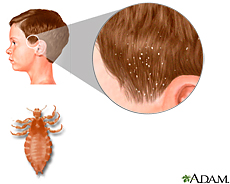
There are three forms of lice, namely thenit, the nymph, and the adult louse.
Nit: Nits are lice eggs. Nits are hard to see and are often confused with dandruff or hair-spray droplets. Nits are found firmly attached to the hair shaft. They are oval and usually yellow to white. Nits take about a week to hatch.
Nymph: The nit hatches into a baby louse called a nymph. It looks like an adult he
ad louse but is smaller. Nymphs mature into adults about seven days after hatching. To live, the nymph must feed on blood.
Adult: The adult louse is about the size of a sesame seed, has six legs, and is tan to grayish-white in color. In people with dark hair, the adult louse looks darker. Females lay nits; they are usually larger than males. Adult lice can live up to 30 days on a person's head. To live, adult lice need to feed on blood. If the louse falls off a person, it dies within two day


What are the signs and symptoms of head lice infestation?

  • a tickling feeling of something moving in the hair;
  • itching (caused by the an allergic reaction to the bites);
  • sores on the head (caused by scratching);
  • these sores on the head can sometimes become infected;
  • irritability.

Where are head lice most commonly found?

Head lice are most frequently located on the scalp behind the ears and near the neckline at the back of the neck. Head lice hold on to hair with hook-like claws that are found at the end of each of their six legs. Head lice are rarely found on the body, eyelashes, or eyebrows.

Head Lice Treatment

Treatment of the individual and the infected family members
Over-the-counter (OTC) or prescription medications are used to treat the affected people and their families. Follow these treatment steps:
  1. Remove all clothing.
  2. Apply lice medicine, also called pediculicide, according to the label instructions. If your child has extra-long hair, you may need to use a second bottle. WARNING: Do not use a cream rinse or combination shampoo/conditioner before using lice medicine. Do not rewash hair for one to two days after treatment.
  3. Have the infested person put on clean clothing after treatment.
  4. If some live lice are still found eight to 12 hours after treatment but are moving more slowly than before, do not retreat. Comb dead and remaining live lice out of the hair. The medicine sometimes takes longer to kill the lice.
  5. If, eight to 12 hours after treatment, no dead lice are found and lice seem as active as before, the medicine may not be working. See your health care professional for a different medication and follow their treatment instructions.
  6. Nit (head lice egg) combs, often found in lice medicine packages should be used to remove nits and lice from the hair shaft. Many flea combs made for cats and dogs are also effective.
  7. After the initial treatment, check, comb, and remove nits and lice from hair every two to three days.
  8. Retreat in seven to 10 days.
  9. Check all treated people for two to three weeks until you are sure all lice and nits are gone.
Treating the house:

Treating the whole house is a laborious but important task. Follow these steps:
  1. Machine wash all washable clothing and bed linens that the infested person touched during the two days before treatment (to kill the lice and nits). Use the hot water cycle (130 F; 55 C) to wash clothes. Dry laundry using the hot cycle for at least 20 minutes.
  2. Dry clean clothing that is not washable (coats, hats, scarves, etc.), orstore all clothing, stuffed animals, comforters, etc., that cannot be washed or dry cleaned into a plastic bag and seal it for two weeks.
  3. Soak combs and brushes for one hour in rubbing alcohol, Lysol, or wash with soap and hot (130 F; 55 C) water and then place in bag and leave in freezer for two days.
  4. Vacuum the floor and furniture. Do not use fumigant sprays. (They can be toxic if inhaled.)

Reviewed by William C. Shiel Jr., MD, FACP, FACR on 5/29/2012


New Parent Mistakes


All parents make mistakes. Don't believe it? Just think about your own parents. You will no doubt come up with a laundry list of things they did wrong.The truth is no one is infallible -- especially new parents. But if you know the top 10 most common parenting mistakes, maybe you can keep from making them yourself. So here they are, along with tips to help you avoid making them.


1: Panicking Over Anything and Everything

Many new parents have overblown physical reactions to spitting up, vomiting, and other things a baby does,' explains New York City psychoanalyst Leon Hoffman, MD, 'and the baby picks up on that anxiety.' Hoffman is the director of the Pacella Parent Child Center. He tells WebMD that parents can literally waste the entire first year of their baby's life by sweating the small stuff. Is he having too many bowel movements or too few? Is she spitting up too much? Is she getting enough to eat or too little? Does he cry too much or not enough? Any of that sound familiar to you? Hoffman says, 'This worry gets in the way of being spontaneous and enjoying your infant's first year of life. Babies are far more resilient than we give them credit for.


2: Not Letting Your Infant Cry It Out

'We, as parents, think our job is to make sure the baby is not crying,' says Atlanta-based pediatric nurse Jennifer Walker, RN. "That's because we associate crying with the fact that we are doing something wrong and we need to fix it." Walker is coauthor of The Moms on Call Guide to Basic Baby Care. 'Babies are designed to cry,' she tells WebMD. They can be perfectly diapered and fed and still cry like you are pulling an arm off.'
For the most part, crying is just part of being a baby. But if your infant is inconsolable for an hour and crying is associated with fever, rash, or persistent vomiting, call your pediatrician as soon as possible.

3: Waking Baby Up to Breastfeed

Mistake or misconception? 'Breastfed babies can -- and should -- sleep through the night,' says Walker. 'But there's a common misconception that breast milk is not thick enough to get an infant through the night. But it is possible and beneficial for breastfed babies -- and their moms -- to sleep through the night.

4: Confusing Spit-Up and Vomit

Walker says, 'The difference (between spit-up and vomit) is frequency, not forcefulness. Spit-up can absolutely fly across the room.' Vomiting, however, is all about frequency. 'If your baby is vomiting with a gastrointestinal virus,' she says, 'it will come every 30 or 45 minutes regardless of feeding.

5: Not Sweating a Fever in a Newborn

Any fever over 100.4 rectally in the first three months of a baby's life is an emergency,' Walker says. The one exception is a fever that develops within 24 hours after an infant's first set of immunizations. Walker tells WebMD, 'Some parents may just say, 'He feels warm' and give the baby Tylenol. But that's a parenting mistake in this age group. An infant's immune system is not set up to handle an infection on its own.


6: Not Properly Installing the Car Seat

Any new parent who has tried knows that installing a car seat is -- or at least can seem like -- rocket science. 'Once you have chosen the right seat,' Walker says, 'go to your local fire station or Babies"R"Us or another chain store to make sure you have installed it correctly.' Or go to get help putting it in. 'Your infant's life,' she says, 'may depend on it.

7: Neglecting Oral Care

Many new parents don't think about their newborns teeth or oral health until it is too late,' says Saul Pressner, a New York City-based dentist. Your baby is never too young for you to start encouraging good oral health habits. Pressner offers tips to help new parents know how to do that:
  • Don't give your infant milk in bed once teeth have erupted. "This will increase the risk of developing cavities," Pressner says, adding that the cavities are also known as baby bottle decay.
  • Use a wet gauze to wipe down your baby's gums, he says. And start using a toothbrush when the baby turns 1.
  • It's also important to make sure your child is getting enough fluoride. Fluoride is found naturally in water and aids in cavity prevention. Some towns have fluoridated water through the taps. 'If yours doesn't,' says Pressner, 'ask your dentist about supplements.


8: Ignoring Your Marriage

Staying connected within the marriage when you first have a child is really important and can be overlooked,' says John C. Friel, PhD. Friel is a licensed psychologist with private practices in Reno, Nev., and Minneapolis, Minn. 'Any weakness in that relationship will get magnified by having a child,' he says. 'And while you have to focus a lot on the new baby, you must somehow maintain a sense of being a couple.' Friel is also the coauthor of The 7 Worst Things (Good) Parents Do. Friel advises to avoid this common parenting mistake by 'making sure that you are not zoning out when you are not with the baby.

9: Fighting Too Much (or Too Little) in Front of Your Baby

Even a 3-month-old will pick up vibes,' Friel says. In terms of fighting, he suggests you ask yourself 'Is it scary?' or 'Is it frequent?' 'Look at the intensity and frequency of your fights,' he says. 'Snapping every now and then is a normal part of living with another person. And when people start to suppress too much, it's just as bad as going to the other extreme.

10: Trusting Unreliable Sources for Parenting Advice

Many new parents go to the wrong places for parenting advice,' says Walker. 'This is a classic parenting mistake,' she says, and she advises that you be careful about where you get your information. Walker says, 'WebMD.com, the Federal Centers for Disease Control and Prevention (CDC), and the American Academy of Pediatrics are reputable and useful when making decisions about general medical care and immunizations.


---------------------------------------------------------------------------------------------


Saturday, April 13, 2013

Party Hat and Crown Templates


Kids can use these easy templates to create fun projects to keep or give as gifts.
Download our basic party hat template -- then let the kids unleash their creativity by adding buttons, paper scraps, and more!


One simple craft turns any birthday party into a good time, guaranteed. But you don't have to trudge to the store for supplies -- chances are you've already got what you need. Paper bags, cardboard scraps, and small boxes become jewelry, toys, and partywear when kids decorate them with items you've scavenged from around the house. Just set a table filled with inspiring odds and ends, such as buttons, trimmings, stickers, even drinking straws, along with scissors and glue.
Get kids started by cutting basic shapes, such as flowers, beforehand. Then leave it up to them to create a favor that's sure to be their favorite. See below for instructions on crafting party hats and bracelets, or try other easy creations like picture frames, brooches, cars, flowers, or masks.

Use What You Have On HandHere are some ideas for everyday items you can use for embellishing.
Buttons
Fabric scraps
Wrapping paper
Wallpaper samples
Tissue paper
Crepe paper
Stickers
Sequins
Trimmings
Yarn
Glitter
Colored tape
Newspaper
Rubber bands

Party Hat How-ToLet party guests put their own crowning touch on the occasion by creating festive hats from paper and materials from a junk drawer. Print the template onto legal-size paper; trace onto sturdy paper and cut out. Overlap ends by 1/2 inch, and tape.


----------------------------------
http://www.marthastewart.com

you may also like:
Town House Gift Boxes